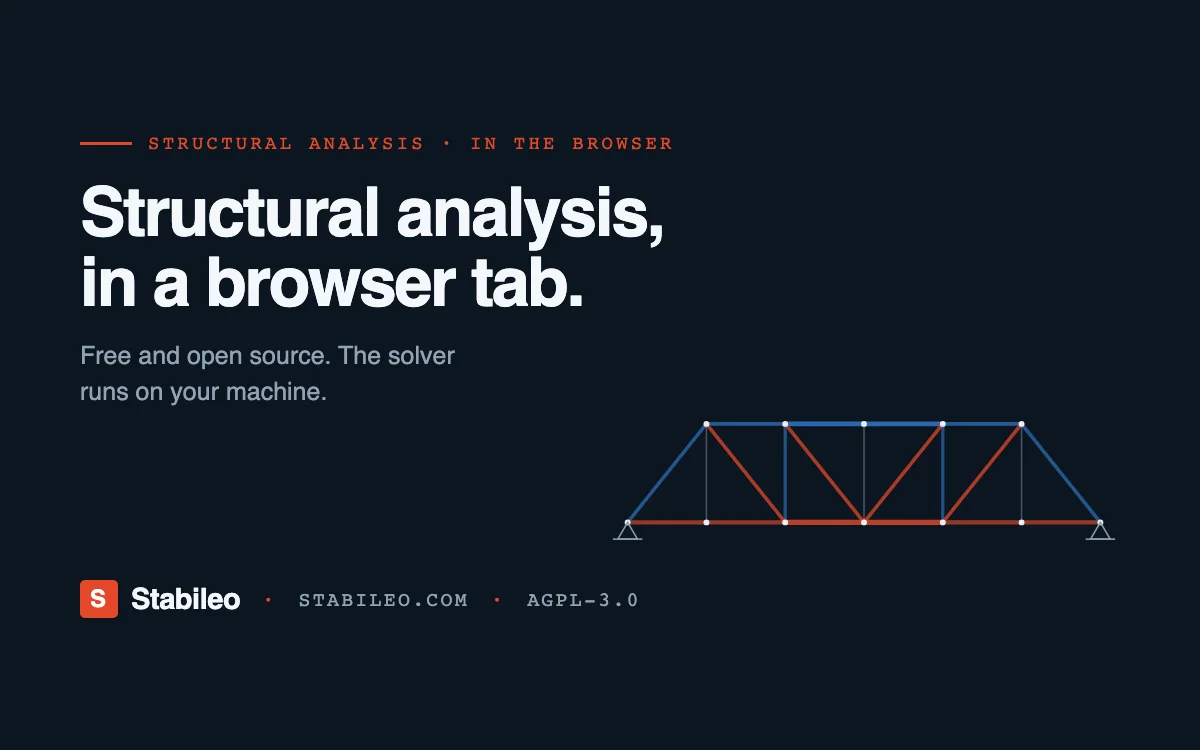
Stabileo is a structural analysis platform that runs in the browser. The solver is written in Rust and compiled to WebAssembly, so models are solved on the user’s own machine with nothing to install. The code is published under the AGPL-3.0 license.12
Modules
The Basic module solves 2D and 3D frames and trusses with the direct stiffness method and returns internal force diagrams and member stresses. Models can be loaded from Excel templates and shared as links. It is free.1
The PRO analysis module adds slabs and walls, staged construction, and non-linear and dynamic analysis, with import from DXF and IFC files. The PRO design module checks elements against CIRSOC, the Argentine structural codes, and is structured so other countries’ codes can be added. Both are in development and open to anyone who wants to try them. An education module lets teachers write exercises inside the app and send them to students as links. It is free for universities.1
AI and the solver
On August 12, Bautista Chesta, Raúl Bertero, Federico Carrone, and Diego Kingston published the architecture for Stabileo AI, an agent that builds, reviews, and explains models, adapted from a paper presented at JAIE 2026. The agent interprets requests and proposes typed changes. Every number comes from the deterministic solver, which the agent cannot modify. The AI module will be priced to cover its running costs.31
The solver is written from scratch in Rust with no external linear-algebra dependencies. It has about 6,800 passing tests, and on the same models its results differ from a commercial program by less than 0.1%. In one worked example, enlarging the beam of a concrete portal frame from 25×40 to 30×55 cm raises its governing moment from 80.8 to 105.6 kN·m. The beam passes only because its capacity rises faster, so the frame has to be solved again rather than estimated. In another, removing an interior ground-floor column from a three-storey frame raises a beam’s governing moment from 54.2 to 203.9 kN·m.3